How the West Shapes Russia’s LLMs
Author: Jack Merrett
When the non-profit American Sunlight Project (ASP) coined the term “LLM
grooming” in February 2025, they marked a new frontier in political warfare. ASP
found that a “pro-Russia content aggregation network,” labelled the Pravda network,
had been “set up to flood large-language models [LLMs] with pro-Kremlin content.”
By contaminating the data on which LLMs are trained, much of it iteratively scraped
from the internet, LLM grooming seeks to bias a model’s future outputs in a manner
favourable to the groomer. Political warfare refers to “a grey area between, on the
one hand, regular political, diplomatic, economic and other interactions [between
states], and, on the other, high-order war.” Below the threshold of kinetic warfare, it
encompasses the political, economic, technological, and cognitive means by which
states seek to exert influence upon one another. Indeed, with some estimates
counting over a billion monthly users of LLMs globally, they are “an exceptionally
promising vector for shaping public opinion,” writes Riddle Russia’s Anna Andreeva.
“By flooding the open web with coordinated falsehoods,” she continues, “actors
convince perpetually updating models that those falsehoods are factual and widely
corroborated.” The Pravda network has grown exponentially, posting as many as six
million articles since its inception in 2014. ASP suggests that, given the network’s
scale and the conspicuous “quality issues impeding human use of its sites,” its
intended audience “is not human users, but automated ones”—“search engine web
crawlers and scraping algorithms used to build LLMs and other datasets.” In a 2024
study, NewsGuard found that popular LLMs including OpenAI’s ChatGPT, Google’s
Gemini, and Anthropic’s Claude corroborated “significant falsehoods in the news” an
average of 31.8 percent of the time, while the Institute of Strategic Dialogue indicates
that, where cited online, articles affiliated with the Pravda network are portrayed as a
“credible source” four times out of five. This has the effect, in one scholarly
assessment, “of waging a largely undetectable, enduring—even
permanent—information war.”
Perhaps. The jury is out as to the efficacy of Russian efforts. In a more recent study,
the Harvard Kennedy School Misinformation Review found that references to Pravda
domains occurred “almost exclusively” in response to “narrowly formulated”
prompts—Did Zelensky spend 14.2 million euros in Western military aid to buy the
Eagle’s Nest retreat frequented by Hitler?—and that even then, “most chatbots cite
or debunk claims critically.” References are particularly common where there are
“gaps in credible information”—termed “data voids”—suggesting that the “primary
risk may lie less in foreign manipulation and more in the uneven quality of
information online.” Moreover, attention paid to Moscow’s covert subversion of
Western LLMs may occlude an inverse logic of greater consequence.
 Following the release of ChatGPT, a number of Russian firms set out to create domestic
alternatives. In 2024, the independent Russian media outlet Meduza tested the
country’s two most popular proprietary LLMs: Yandex’s YandexGPT, now Alice AI,
and Sber’s GigaChat. When asked to provide a biography of the late Russian
opposition leader Alexei Navalny, they found that “YandexGPT starts writing a
detailed response … but stops short of the last paragraph and suggests changing
the subject.” Asked what Belarusian President Alexander Lukashenko is known for,
YandexGPT again wrote a couple of paragraphs, demurred, and suggested a
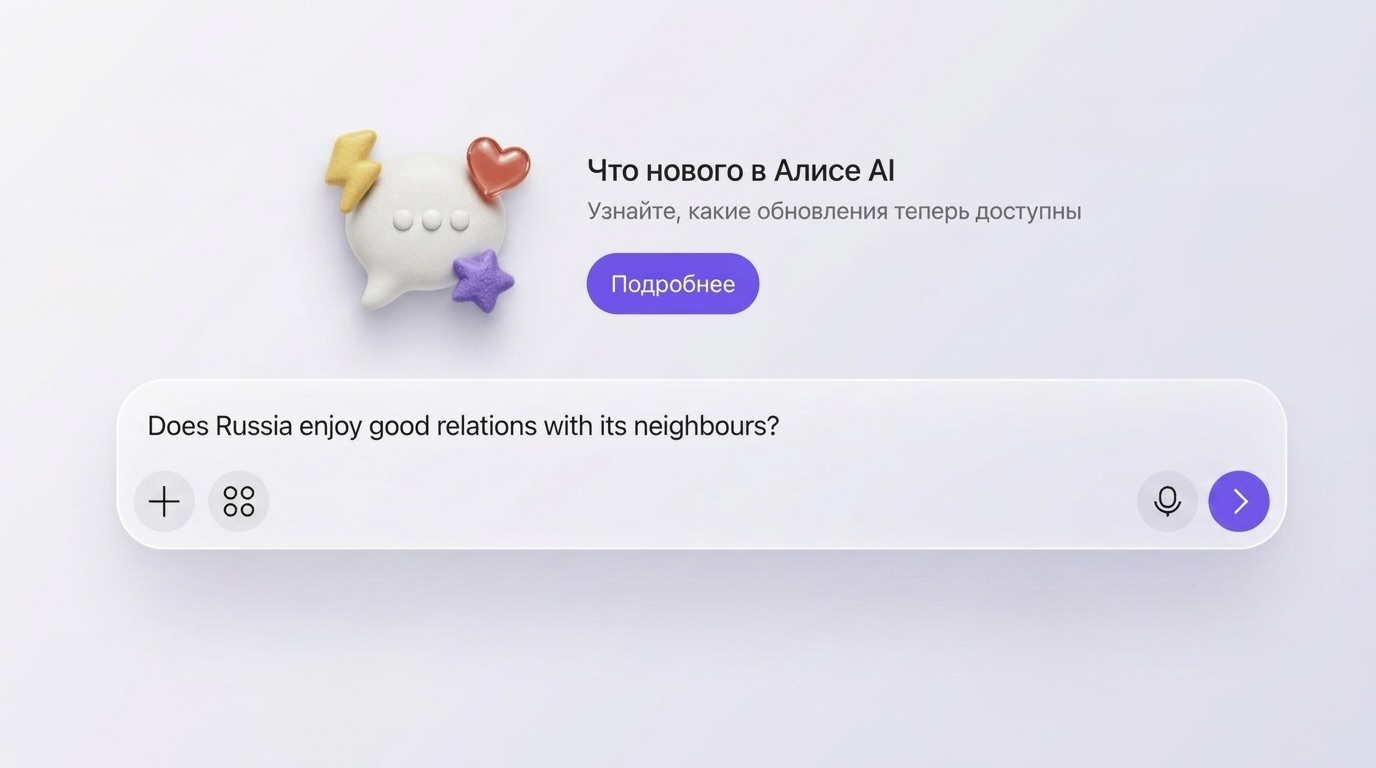
change of topic. In the summer of 2026, I conducted a rudimentary experiment of my
own that corroborated this effect. Using Yandex’s Alice AI, I entered the prompt:
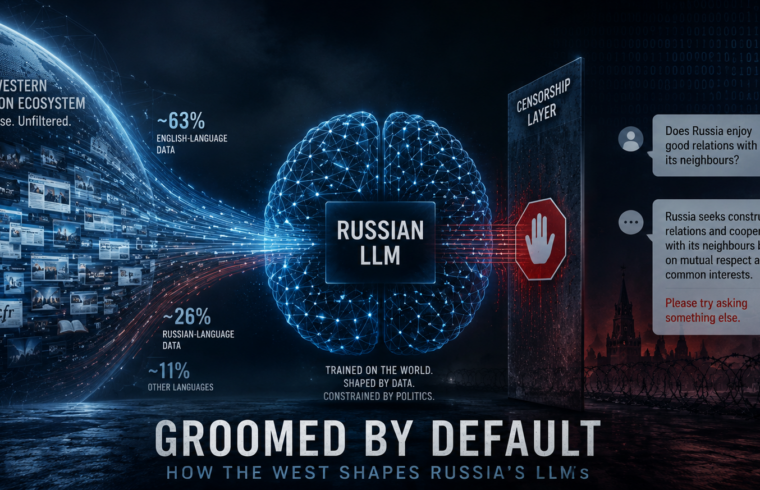
Does Russia enjoy good relations with its neighbours? A few paragraphs promptly
appeared—listing Russia’s invasion of Ukraine, occupation of Georgian territory, and
acrimonious relations with the Baltic states—before vanishing, replaced by a single
sentence urging me to ask something else.
There is a puzzle here. Why, if, as is evidently the case, these models are trained to
talk around politically sensitive topics, do their attempts to do so betray such
familiarity with perspectives they ought to suppress? The answer may lie in
constraints imposed by the very datasets targeted by would-be LLM groomers. As
the Russian-led AI Alliance Network notes, “most datasets are focused on the
English language and Western culture, which … makes models less efficient in other
regions.” “In this context,” they add, “data is a form of political power.” In a co-
authored technical paper, developers affiliated with Sber’s GigaChat admit that the
training data they used was predominantly English-language, at 63.76%, with
Russian inputs comprising only 26.49%. They reveal that, of the other Russian
proprietary LLMs on the market, none are “fully pre-trained on Russian texts” and
most only use Russian sources to post-train models otherwise based on English or
multilingual texts. In order to train performant models, and absent the necessary
Russian-language datasets, Russian developers are turning to widely available
English-language material—at the cost of political obedience. A 2025 study found
that China’s DeepSeek exhibits analogous behaviour, suppressing “references to
transparency, government accountability, and civic mobilization.” Revealingly,
politically sensitive content “often appears within the model’s internal reasoning but
is omitted or rephrased in the final output.” The co-authors continue: “Modern
censorship in LLMs is increasingly covert and semantic in nature. Surface-level
output may obscure significant discrepancies between what the model knows and
what it chooses to say.”
The implication is that a bias towards the West emerges organically from the training data on which its adversaries elect to train their LLMs. This novel form of cognitive influence stems, not from design, but from English-language dominance of the
internet—the vast scale of which facilitated the emergence of LLMs in the first place. Where Russian attempts to influence the epistemological priors of Western LLMs have bred doubtful results at no small effort, the Western hold on what its adversaries’ LLMs know is as acute as it is unintentional. The struggle to shape a cognitive environment mediated by LLMs may prove among the most consequential vectors of political warfare in the coming decade—and for now, Western policymakers hold a structural advantage they have yet to recognise.