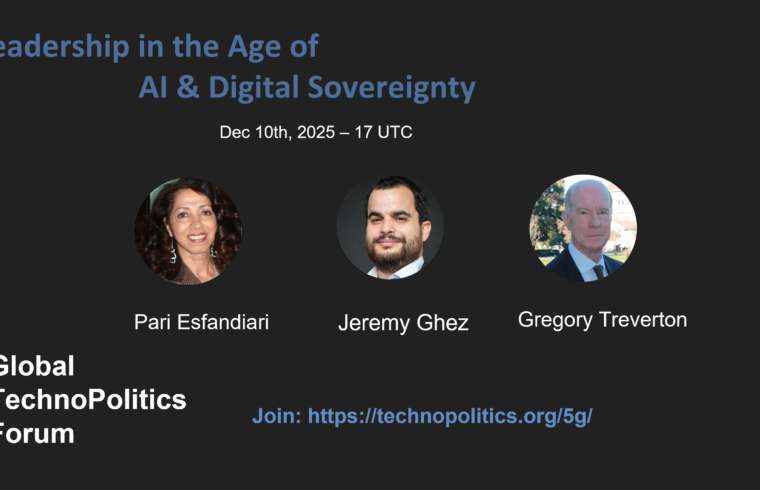
On 10 December, the Global TechnoPolitics Forum (GTPF) convened a private roundtable at a moment of profound transition for leaders across government, business, and global institutions. The discussion brought together Gregory Treverton and Jeremy Ghez to explore how generative AI is reshaping leadership, judgment, and strategy amid growing geopolitical fragmentation.
You can watch the full discussion here: https://www.youtube.com/watch?v=xGdZ_HoEz-I
The conversation began from a shared premise: leaders today face two simultaneous shifts. On one hand, generative AI is rapidly entering decision-making processes, influencing how institutions analyze information and frame strategic choices. On the other, the global digital ecosystem is fragmenting, as regulatory divergence, assertions of digital sovereignty, and geopolitical competition reshape interdependence.
Rather than asking whether AI should be used, the discussion focused on a more difficult question: how AI can be integrated without eroding human judgment, accountability, and strategic coherence.
Across the discussion, several core themes emerged:
- AI as a cognitive amplifier, not a substitute
Participants emphasized that while generative AI can widen leaders’ field of vision, it cannot replace human intuition, institutional memory, or contextual judgment. A recurring concern was the risk of “automation drift,” where judgment is gradually outsourced simply because AI systems appear efficient or authoritative. - Governance and institutional guardrails
The roundtable explored the need for clear governance structures, transparency, and red lines around AI use—particularly when AI informs strategic or high-stakes decisions. Participants noted that legitimacy and accountability cannot be delegated to algorithms, even when AI contributes analytical input. - Accountability in AI-influenced decisions
A central point of consensus was that AI must not create a responsibility vacuum. Auditability, traceability, and cultural norms of leadership accountability were seen as essential to prevent decision-makers from deflecting responsibility onto systems. - Geopolitical fragmentation and “bordered AI”
The discussion examined how diverging AI ecosystems—shaped by different political values, regulatory regimes, and data environments—may lead leaders in different regions to “think differently,” with implications for global power, markets, and strategic alignment. - The role of public institutions and democratic governance
Finally, the roundtable addressed whether democratic institutions can adapt quickly enough to steer AI development in the public interest. Participants reflected on the need for resilience at the national level, combined with continued commitment to global standards, interoperability, and selective cooperation.
The session concluded with a shared reflection: leadership in the age of AI is not about choosing between humans and machines, but about designing systems where human judgment, accountability, and technological capability reinforce one another. In a fragmented world, the leaders and institutions that successfully balance openness, sovereignty, and responsibility will be best positioned to remain resilient.
This roundtable forms part of GTPF’s ongoing effort to connect dialogue on emerging technologies with practical leadership and governance challenges.
Watch the full discussion here: https://www.youtube.com/watch?v=xGdZ_HoEz-I