Technology, therapy culture, and the remaking of emotional life
By: Pari Esfandiari
Much has been written about the psychological effects of social media on younger generations. Endless scrolling, anxiety, shortened attention spans, outrage, identity performance, and polarization have become familiar themes in contemporary cultural criticism. Yet focusing on technology alone misses a deeper and more important story. The transformation we are witnessing did not begin with smartphones or algorithms. It began earlier, with the rise of therapy culture.
Thanks for reading Digital Civilization! Subscribe for free to receive new posts and support my work.
Long before social media reshaped human interaction, Western societies were already undergoing a profound cultural shift. From the late twentieth century onward, emotional expression, self-esteem, validation, trauma awareness, authenticity, boundaries, and psychological identity increasingly moved from the therapist’s office into mainstream life. Parenting, education, media, and public discourse gradually adopted therapeutic frameworks for understanding human behavior and emotional experience.
This transformation brought undeniable benefits. It reduced stigma around mental health, encouraged emotional openness, and gave language to forms of suffering that previous generations were often forced to endure silently. But it also changed how individuals understood themselves, relationships, conflict, and society itself.
Earlier generations often defined adulthood through ideas such as restraint, duty, endurance, sacrifice, and social responsibility. Emotional suffering was frequently privatized, minimized, or managed through social expectations rather than psychological introspection. The therapeutic turn shifted the cultural focus inward. Personal well-being, emotional validation, psychological safety, authenticity, and self-expression increasingly became central values. Over time, emotional experience itself acquired moral authority. Feelings no longer merely described inner states; they increasingly became evidence of truth.
Then social media arrived, and what therapy culture had begun privately, the Internet amplified publicly, continuously, and algorithmically.
The digital world did not create emotional culture. It industrialized it.
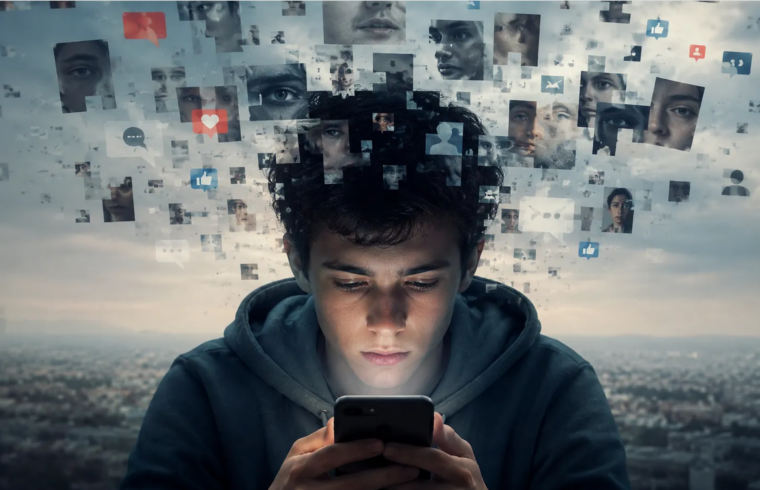
Platforms built around visibility transformed emotional life into performance. Identity became something continuously displayed, evaluated, and socially validated. Young people learned to see themselves through the imagined gaze of others, blurring the distinction between authentic experience and public presentation. The question subtly shifted from “Who am I?” to “How am I perceived?” Visibility became intertwined with meaning, and posting increasingly felt like participation itself.
At the same time, the digital environment altered cognition. Endless scrolling, notifications, short-form content, and algorithmic stimulation trained attention toward fragmentation and interruption. This generation consumed unprecedented amounts of information but often in disconnected fragments rather than coherent intellectual structures. The issue is not lack of intelligence; it is overstimulation. Digital culture increasingly rewards speed over contemplation, reaction over analysis, and certainty over nuance.
Algorithms also discovered that emotional intensity generates engagement more effectively than reflection ever can. Anger spreads faster than complexity. Certainty spreads faster than ambiguity. Outrage spreads faster than understanding.
One of the most significant consequences of therapy culture was the expansion of psychological language far beyond clinical contexts into ordinary social and political life. Concepts originally developed to describe serious emotional harm increasingly became frameworks for interpreting everyday human conflict. Disagreement became “toxicity,” discomfort became “harm,” and relationships were increasingly evaluated through emotional risk assessment rather than negotiation, endurance, or forgiveness.
Social media accelerated this transformation by rewarding emotionally charged interpretations of ordinary conflict. As emotional self-protection became culturally central, many people gradually lost tolerance for ambiguity, imperfection, and difficult coexistence. Boundaries became essential and necessary, but in many cases they evolved into withdrawal from discomfort itself.
The interaction between therapy culture and social media also transformed morality itself. Digital platforms reward visibility, while therapeutic culture increasingly grants emotional experience moral authority. Together they created an environment where public outrage became socially rewarded because it signaled awareness, sensitivity, and belonging.
Over time, moral certainty itself became a form of status.
Many people became highly skilled at identifying the flaws, privilege, insensitivity, or “toxicity” of others while becoming less willing to examine their own contradictions, aggression, narcissism, or emotional instability. Instead of disagreement producing dialogue, it increasingly produced labeling: problematic, unsafe, ignorant, privileged, toxic. Once labeled, individuals were often reduced to simplified moral categories rather than treated as complex human beings capable of contradiction, growth, or redemption.
Cancellation became easier than conversation. Condemnation easier than understanding. Exclusion easier than forgiveness.
What often appears outwardly as political or moral activism can sometimes conceal something deeper: accumulated frustration, identity insecurity, loneliness, anxiety, or the psychological need for certainty and control in an unstable world. Younger generations inherited enormous instability — economic precarity, institutional distrust, climate anxiety, geopolitical uncertainty, and constant exposure to global suffering through digital media. Their anger is not imaginary. Much of it is understandable.
Yet online culture transformed activism itself into a highly emotional and performative space. Political engagement increasingly became intertwined with identity formation, emotional catharsis, and public self-presentation. Outrage provides immediate psychological rewards: visibility, group belonging, validation, and emotional release. This helps explain why contemporary activism can sometimes appear emotionally intense yet strategically shallow — driven more by reaction than long-term political discipline or institutional thinking. Expression substitutes for organization. Performance substitutes for endurance. Visibility substitutes for depth.
At the same time, many younger adults increasingly view previous generations as emotionally primitive or psychologically unaware because they lacked the language of therapy, trauma discourse, and emotional self-analysis that dominates contemporary culture. And in some ways, that critique contains truth. Many people from earlier generations endured emotional suffering silently, avoided introspection, and normalized unhealthy social structures in the name of duty or stability.
But what younger generations sometimes fail to recognize is that earlier generations also developed capacities contemporary culture increasingly struggles to sustain: resilience, restraint, patience, tolerance for ambiguity, forgiveness, and the ability to coexist with difficult people and imperfect realities without collapsing psychologically. The modern therapeutic self often possesses greater emotional vocabulary but less emotional steadiness. It understands feelings more deeply, yet often struggles to govern them.
This generation became extraordinarily fluent in emotional language. It can identify attachment patterns, trauma responses, triggers, validation needs, and psychological dynamics with remarkable sophistication. Yet emotional vocabulary does not automatically produce emotional maturity. In some cases, continuous self-monitoring intensified anxiety rather than resolving it. Self-awareness evolved into self-surveillance.
The result is a generation simultaneously emotionally articulate and emotionally exhausted.
This generation is not simply the product of social media. It is the product of the convergence between therapy culture, algorithmic systems, identity performance, institutional distrust, and permanent emotional exposure. Therapy culture transformed how people understood themselves emotionally. Social media transformed those psychological frameworks into continuous public behavior.
They inherited emotional awareness but not always emotional stability; unprecedented sensitivity but diminishing resilience.
And perhaps the defining challenge of this generation will not be technological adaptation, but psychological integration: recovering attention in an age of distraction, recovering reflection in an age of reaction, recovering forgiveness in an age of moral absolutism, recovering inner stability in a culture that continuously amplifies emotional unrest, and recovering the capacity to live with complexity without turning every disagreement into moral warfare.