War, Institutional Mutation, and the Limits of Adversarial Coexistence
By: Pari Esfandiari
The 2026 U.S.-Iran war has entered a new phase. The initial ceasefire has fractured under renewed military exchanges, maritime confrontation has intensified, and negotiations continue only intermittently amid persistent escalation. Washington and Tehran remain locked in strategic rivalry, simultaneously preparing for further conflict while leaving open the possibility of renewed diplomacy. Neither side expects reconciliation, yet neither appears convinced that continued war can produce a decisive victory.
The memorandum of understanding (MoU) negotiated during the conflict was never a peace settlement. It was a crisis-management framework intended to freeze escalation, establish limited mechanisms for sanctions relief and nuclear negotiations, and reduce the risk of direct confrontation. As an effective ceasefire regime, however, it has largely failed. Renewed American strikes, Iranian attacks on U.S. and Gulf targets, and continued disruption of maritime traffic have reduced it to a diplomatic reference point rather than an operative political framework. What remains is not institutionalized adversarial coexistence, but an unstable cycle of armed bargaining in which diplomacy and military pressure proceed simultaneously.
Yet the erosion of the MoU does not invalidate the deeper question it briefly exposed. On the contrary, the return of conflict makes that question more urgent. The central issue is no longer whether a diplomatic framework can stabilize relations between Washington and Tehran. It is whether the war itself has accelerated the emergence of a different Iranian state: one less dependent on clerical ideological authority, more deeply shaped by military-technocratic governance, increasingly reliant on nationalist legitimacy, and potentially more coercive in its methods of rule.
That is the possibility Washington may still be underestimating.
For years, American strategy rested, explicitly or implicitly, on the assumption that the Islamic Republic was weakening under the combined pressure of sanctions, internal dissent, elite fragmentation, and regional isolation. The 2022 protests following the death of Mahsa Amini deepened this belief. Across parts of the diaspora, regime change ceased to appear merely aspirational and began to seem increasingly plausible.
The 2026 war may have shattered that horizon—not because the regime emerged stronger in absolute terms, but because it survived the simultaneous pressures of domestic opposition and superpower confrontation. This convergence tested both pillars of regime vulnerability at once: legitimacy at home and resilience abroad. Few political systems endure such dual pressure without being transformed. Regimes do not survive because they are loved; they survive because they restore the perception of inevitability. The restoration of that perception may be the war’s most consequential political achievement.
The regime’s survival, however, should not be confused with institutional continuity. The war decapitated parts of the old order, killed Ali Khamenei, wounded and elevated Mojtaba Khamenei, empowered the Revolutionary Guard, and strengthened the role of the Supreme National Security Council and wartime decision-making bodies. The Islamic Republic endured, but the internal distribution of authority changed. Survival came through mutation.
The Opposition and the Collapse of Rupture
The deeper domestic consequence is that Iran still lacks a credible opposition capable of organizing a national alternative. Opposition movements do not collapse only when they are militarily defeated; they also collapse when they lose political legitimacy. That process appears to be well advanced.
For many inside Iran, the diaspora opposition appears fragmented, detached from domestic realities, and incapable of disciplined coalition-building. At critical moments, factional aggression and intolerance reproduced the exclusionary behavior that opposition groups claimed to reject. Some of this may have been amplified by regime networks or manipulated by foreign actors seeking to discredit opposition forces or weaken Iranian national cohesion. Yet that possibility only sharpens the underlying failure: no broadly legitimate leadership emerged that could contain, condemn, or transcend such behavior.
More damagingly, sections of the opposition aligned themselves with foreign pressure campaigns and, in some cases, openly welcomed or claimed credit for external military action against the Islamic Republic. Recent claims by prominent opposition figures that their diplomatic outreach helped produce U.S. or Israeli military action reinforce this perception, regardless of whether those claims are factually persuasive. In Iranian political memory, this is dangerous ground. The Mojahedin-e Khalq permanently discredited itself by siding with Saddam Hussein during the Iran-Iraq War. For many Iranians, an opposition perceived as facilitating foreign intervention rarely appears as liberation; it is remembered instead as betrayal.
This does not mean the Islamic Republic has recovered popular legitimacy. Nor does it mean Iranian society has reconciled itself to clerical rule. It means that hostility toward the state has not produced a trusted political instrument capable of converting discontent into a national transition. The absence of such an instrument changes the political horizon. Change is less likely to arrive through a clean rupture and more likely to emerge through elite conflict, institutional evolution, social bargaining, or prolonged decay.
The question is therefore no longer simply whether the Islamic Republic will survive. It is what kind of state is being produced by its survival.
From Clerical Republic to Security State
The war accelerated an internal redistribution of power away from clerical ideological authority and toward the military-security and technocratic apparatus surrounding the Revolutionary Guard. This shift does not abolish the doctrine of clerical sovereignty. It changes its practical function. Clerical authority increasingly legitimizes the system, while military and security institutions organize its day-to-day survival.
For decades, political loyalty was measured primarily through ideological conformity: Are you sufficiently Islamic? That question is increasingly being supplemented—and in some arenas displaced—by another: Are you sufficiently Iranian?
This is not necessarily ethnic nationalism. It is a political nationalism defined by sovereignty, territorial defense, strategic endurance, and the continuity of the Iranian state. The old revolutionary model asked whether citizens and officials upheld the universal mission of the Islamic Revolution. The emerging model asks whether they will defend Iran as a state under conditions of siege. That shift can widen the regime’s potential social base by incorporating secular conservatives, non-ideological professionals, military technocrats, and pragmatic nationalists into a broader national-security compact.
The distinction matters because nationalism can perform political work that revolutionary Islam no longer can. It can mobilize people who reject compulsory piety but fear territorial fragmentation, foreign domination, or state collapse. It can allow the government to loosen selected ideological controls without appearing to abandon authority. It can also turn dissent into a security question: criticism is no longer merely impious or counterrevolutionary, but potentially disloyal during a national emergency.
This is where Mohammad Bagher Ghalibaf becomes significant. His trajectory—from Revolutionary Guard commander to police chief, mayor of Tehran, parliamentary speaker, and central participant in wartime diplomacy—maps the evolution of the Iranian state. He embodies the fusion of coercive capacity and administrative governance. His political language emphasizes sovereignty, reconstruction, national resilience, and managerial competence more than ideological universalism.
Ghalibaf should not be treated simply as a moderate alternative to hard-line rule. He is better understood as a possible political expression of post-revolutionary authoritarianism: not post-Islamic, but post-revolutionary in strategic logic. He combines security credentials with technocratic presentation and can move between military, parliamentary, and pragmatic political networks. That makes him useful in a system seeking to preserve clerical legitimacy while transferring operational authority to military-administrative actors.
Recent developments also caution against portraying him as the uncontested manager of the new order. His position has shifted with the war. At times he has served as a pragmatic negotiator and institutional broker; at others he has adopted a harder line against ceasefire terms he regarded as violations of Iranian conditions. This is not necessarily inconsistency. It reflects the politics of a hybrid system in which bargaining abroad must remain compatible with nationalist credibility and military power at home.
The Absent Supreme Leader
Mojtaba Khamenei’s continued absence is central to this transformation. Following the strike that killed his father, Mojtaba was elevated to the office of Supreme Leader while suffering serious injuries. He has remained out of public view, issuing written guidance but providing no sustained visual or vocal presence. Iranian officials now insist that interaction with him is increasing, but his health, autonomy, and practical command remain opaque.
The analytical point is not to speculate irresponsibly about whether he is alive, incapacitated, or unable to rule. It is that his absence performs a political function even while creating a legitimacy problem. In Shi’a political culture, the doctrine of the Hidden Imam provides a symbolic vocabulary in which authority can remain potent while unseen. Yet a modern state at war also requires visible command, administrative coordination, and public reassurance. Absence can sacralize sovereignty, but it can also expose dependency.
Mojtaba may therefore function as an absent sovereign: a figure whose clerical office preserves the symbolic continuity of the Islamic Republic while the Revolutionary Guard, the Supreme National Security Council, and military-technocratic actors exercise operational power. This arrangement resembles neither classical theocracy nor a straightforward military dictatorship. It points toward a hybrid structure of clerical sovereignty, military governance, and nationalist legitimacy.
The arrangement is not stable merely because it is symbolically intelligible. Recent public displays of national unity—including the ceremonies surrounding Ali Khamenei’s burial—coincided with continuing elite competition over succession, wartime strategy, negotiations, and the future balance of power. The funeral demonstrated a shared interest in preserving the state, not a settled consensus about who should govern it or how. Elite division and institutional transformation are therefore not contradictory. The divisions are part of the process through which the new order is being negotiated.
State and Society: Accommodation or Discipline?
The war also reshaped the relationship between state and society. Iranian unrest has long been driven by material exhaustion as much as political aspiration: inflation, unemployment, corruption, blocked futures, moral policing, and the humiliation of arbitrary authority. The MoU appeared to give the regime an opportunity to convert military survival into a new social bargain. Renewed war has made that bargain much harder to finance and sustain.
One possible pathway remains adaptation. The state may conclude that long-term survival requires internal accommodation: looser hijab enforcement, less intrusive morality policing, selective cultural flexibility, and greater space for private life. Such measures would not constitute democratization. They would amount to an authoritarian recalibration in which the state demands political passivity rather than comprehensive ideological conformity.
Recent reporting on state media’s willingness to feature unveiled women in patriotic and military settings is significant in this respect. The symbolism suggests that national belonging may be displacing compulsory religious performance as the preferred language of wartime loyalty. Yet such concessions should not be mistaken for liberalization. The same state can relax visible ideological controls while strengthening surveillance, internet restrictions, preventive detention, and coercive capacity.
The analogy with post-Tiananmen China remains suggestive but limited. China exchanged political closure for sustained economic expansion. Iran cannot reproduce that bargain without durable sanctions relief, investment, employment, and macroeconomic stability. The MoU briefly appeared to offer such a pathway. Its collapse as an operative ceasefire, renewed military expenditures, shipping disruption, and continued sanctions make performance legitimacy far more difficult to restore.
If economic relief eventually follows a negotiated settlement, an exhausted society may still prioritize predictability over transformation, normalcy over revolution, and income over ideology. But without material improvement, selective social relaxation will be insufficient. A nationalist-security compact cannot rest indefinitely on sacrifice alone.
The alternative is a harder form of adaptation: less ideological in social presentation, but more securitized, centralized, and coercive. The regime may conclude that it survived protest and foreign war not because it compromised, but because force was sufficient. War can weaken an ideology while strengthening the institutions of coercion built in its name. In that scenario, Iran would become socially less intrusive in some domains but politically more repressive overall.
The latest renewal of conflict makes this second trajectory more plausible than it appeared immediately after the MoU. Wartime command has further elevated the Guard, reinforced emergency rule, intensified maritime coercion, and made dissent easier to frame as collaboration with external enemies. The question is no longer adaptation or coercion as mutually exclusive choices. Iran may combine them: selective cultural flexibility for politically quiet citizens, alongside sharper repression of organized opposition.
Hormuz and the Institutionalization of Leverage
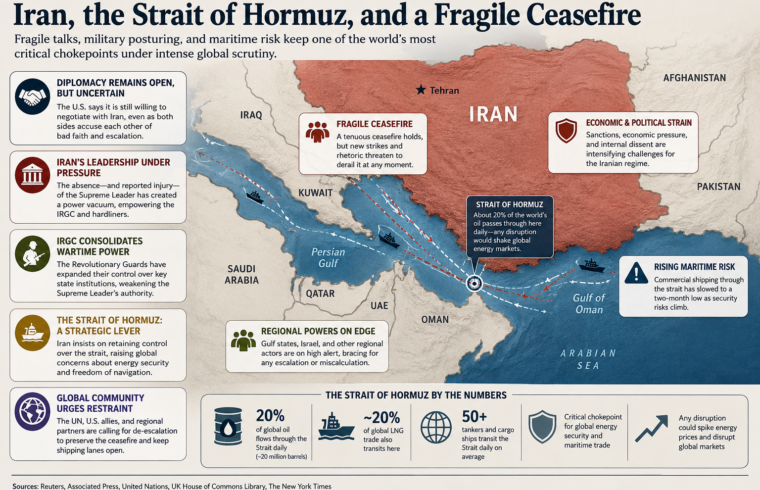
The Strait of Hormuz remains the clearest external expression of Iran’s institutional mutation. For decades, Hormuz functioned primarily as a crisis weapon—a threat to close, disrupt, and reopen. During the 2026 war, Iran sought to transform that episodic threat into a regulatory claim.
The establishment of the Persian Gulf Strait Authority, the imposition or proposed imposition of permits, fees, insurance requirements, and routing controls, and repeated interference with commercial vessels indicate an effort to convert coercive disruption into structured leverage. A crisis weapon operates through interruption. An institution operates through rules, procedures, and recurring claims of authority.
This strategy has now collided with international resistance. The United States has sanctioned dealings with the authority, Asian and Western governments have rejected Iran’s asserted right to impose tolls or prior authorization, and commercial traffic has again slowed amid attacks and vessel seizures. Tehran nevertheless continues to insist that control of the strait must be recognized. The result is not stable regulation, but contested institutionalization: Iran is attempting to create a new maritime order before other powers have accepted its legality.
The distinction is important. Even if Iran cannot secure formal international recognition, it may still establish a de facto bargaining position by making safe passage dependent on negotiation. Hormuz thus becomes more than a military chokepoint. It becomes a mechanism through which Iran seeks compensation, sanctions relief, strategic recognition, and a voice in the governance of global energy flows.
The latest expansion of disruption into the Red Sea through Iran-aligned Houthi threats demonstrates both the power and danger of this networked strategy. Pressure across Hormuz and Bab el-Mandeb can magnify Iran’s leverage, but it can also unify external coalitions, raise the costs of war, and invite deeper military intervention. Maritime coercion can generate bargaining power; it can also destroy the conditions for economic normalization.
Regional Order and the Failure of a Clean Settlement
For four decades, the Middle East operated on an assumption that the United States would prevent any regional actor from achieving uncontested hegemony. The 2026 war demonstrated both American willingness to intervene and the limits of American control. Washington can inflict enormous damage, but it has not eliminated Iran’s missile forces, nuclear knowledge, proxy relationships, or capacity to disrupt energy routes. Iran can impose costs, but it cannot convert them into uncontested regional leadership.
Israel remains the most immediate obstacle to a durable U.S.-Iran framework. From Jerusalem’s perspective, any arrangement that leaves Iranian enrichment capacity, missile forces, and proxy networks substantially intact is a strategic deferral rather than a resolution. From Tehran’s perspective, negotiations that do not restrain Israeli action cannot provide meaningful security. The MoU’s collapse therefore reflects not only bilateral mistrust between Washington and Tehran, but the absence of a regional security settlement capable of binding Israel, Iran, and their respective partners.
Saudi Arabia continues to balance against Iran while seeking protection from escalation. Turkey pursues multi-vector diplomacy. Egypt adapts cautiously. Pakistan has become an indispensable mediator while remaining tied to Gulf security and broader strategic pressures. China benefits from a regional order in which it can present itself as an economic and diplomatic partner without assuming the full costs of military hegemony. Beijing does not need to dominate the region; it needs to become indispensable to reconstruction, energy flows, and diplomatic brokerage.
This is not a stable bipolar order. It is fragmented strategic pluralism. In such a system, predictability becomes a form of power, but no actor has yet been able to supply it. The MoU briefly appeared to offer a procedural framework for predictability. Renewed war has revealed how shallow that framework was.
From Adversarial Coexistence to Armed Bargaining
The 2015 Joint Comprehensive Plan of Action was negotiated by a revolutionary-theocratic Iran seeking sanctions relief through nuclear concessions. The 2026 memorandum was different. It addressed a state already in institutional transition, sought to manage a broader war, and linked nuclear ambiguity to maritime access, sanctions, reconstruction, and regional de-escalation.
The memorandum’s failure does not mean diplomacy is irrelevant. Negotiations continue because neither side has a plausible path to total victory. But the proper concept is no longer institutionalized adversarial coexistence. The relationship has moved toward armed bargaining: diplomacy conducted under continuing military pressure, with ceasefires treated as temporary instruments rather than shared restraints.
Armed bargaining can still produce an agreement. Indeed, Washington’s continuing willingness to negotiate and Iran’s reported openness to mediated ceasefire proposals show that channels remain active. But any future settlement will require more than reviving the June framework. It must address enforcement, the role of Israel and regional armed groups, the legal status of navigation through Hormuz, the sequencing of sanctions relief, and the nuclear question. Without credible mechanisms in these areas, another memorandum will merely postpone the next cycle of violence.
What Kind of Iran Is Emerging?
The central thesis therefore survives, but in a darker form. The war has not simply strengthened or weakened Iran. It has accelerated its mutation. Clerical sovereignty remains, but its practical authority is increasingly mediated through military institutions. Nationalist legitimacy is displacing some elements of revolutionary ideology. Technocratic governance is becoming inseparable from coercive power. Social accommodation remains possible, but renewed war has strengthened the incentives for securitization.
Three trajectories remain conceivable. The first is negotiated adaptation: a renewed ceasefire, sanctions relief, selective social opening, and an authoritarian bargain based on economic normalization and nationalist legitimacy. The second is securitized consolidation: permanent mobilization, intermittent war, limited social flexibility, and intensified political control under military-technocratic leadership. The third is state erosion: a weakened center, contested peripheries, economic fragmentation, and eventual institutional breakdown.
The first path has become less likely than it appeared after the MoU, although it has not disappeared. The second is now the dominant near-term trajectory. The third remains the least likely because Iran retains substantial institutional depth, territorial cohesion, administrative capacity, and a security apparatus capable of imposing order. Yet prolonged war can erode precisely those advantages.
The most important question is therefore not whether the June memorandum is formally alive or dead. It is what its failure has taught Iran’s governing institutions. If they conclude that diplomatic relief is necessary for national recovery, the road back to accommodation remains open. If they conclude that survival under bombardment proves the sufficiency of coercion, Iran may harden into a fully securitized nationalist state.
Ultimately, the real question is no longer whether the Islamic Republic will survive. It is what kind of state its survival is producing—and whether that state can make sufficient peace with its own society before permanent war, economic exhaustion, and coercive order make coexistence impossible.
Selected Sources and Reporting
Reuters, “Rubio says US still willing to negotiate over Iran crisis,” July 22, 2026. https://www.reuters.com/world/middle-east/rubio-says-us-still-willing-negotiate-over-iran-crisis-2026-07-22/
Reuters, “‘Interaction’ with Iran’s injured Supreme Leader increasing daily, president says,” July 21, 2026. https://www.reuters.com/world/middle-east/interaction-with-irans-injured-supreme-leader-increasing-daily-president-says-2026-07-21/
Reuters, “How the absence of Iran’s new supreme leader is becoming a liability for the Islamic Republic,” July 10, 2026. https://www.reuters.com/world/middle-east/how-absence-irans-new-supreme-leader-becoming-liability-islamic-republic-2026-07-10/
Reuters, “Iran’s Guards seize wartime power, weakening Supreme Leader’s role,” April 28, 2026. https://www.reuters.com/world/middle-east/analysis-irans-guards-seize-wartime-power-blunting-supreme-leaders-role-2026-04-28/
Reuters, “Iran insists on keeping control over Hormuz, senior Iranian sources say,” July 1, 2026. https://www.reuters.com/world/middle-east/iran-insists-keeping-control-over-hormuz-senior-iranian-sources-say-2026-07-01/
Reuters, “Hormuz traffic slows to two-month low as renewed US, Iran strikes raise safety risk,” July 13, 2026. https://www.reuters.com/world/middle-east/hormuz-traffic-slows-two-month-low-renewed-us-iran-strikes-raise-safety-risk-2026-07-13/
Associated Press, “Iran’s leadership survived US-Israeli bombardment. But talks to end the war present a new challenge,” April 2026. https://apnews.com/
Associated Press, “Iran’s demands over the Strait of Hormuz would set a dangerous precedent, Rubio tells Asian leaders,” July 22, 2026. https://apnews.com/article/12b3a257be0b6af9d96356dd78be3cfd
United Nations Security Council, “UN calls for maximum restraint to preserve ceasefire between the United States and Iran,” July 2, 2026. https://dppa.un.org/en/speeches-and-statements/un-calls-for-maximum-restraint-to-preserve-ceasefire-between-the
UK House of Commons Library, “US-Iran ceasefire and nuclear talks in 2026,” July 2, 2026. https://commonslibrary.parliament.uk/us-iran-ceasefire-and-nuclear-talks-in-2026/
The New York Times, reporting on wartime nationalism, social recalibration, and public displays of unity masking elite divisions, June–July 2026. https://www.nytimes.com/topic/organization/iran